The same model is often sold by several providers. DeepSeek V4.1 Flash, for example, is served on one installation by Novita and by Evren, behind the same gateway, under two model ids. They are not the same service: one may answer faster, one may refuse a request the other accepts. The benchmark answers that question with a measurement rather than an opinion. This article runs it on your own key and reads the result.
Every number below comes from one run on a live installation on 3 November 2026. The screenshots are from that run.
Before you start: you need access to a Bosphorus installation and a personal platform key on it — one that belongs to you; a team key made by an administrator is refused. If you would like to try it, contact Morten or write to iletisim@morten.com.tr.
Who does what
| Task | Who | Where |
|---|---|---|
| Sign in | Each person | The benchmark app, with the company account |
| Save your own platform key | Each person | My key |
| Run a sweep | Each person | Bench |
| Read and export the result | Each person | Runs & face-off |
| Decide which models a person may test | Administrator | Console, model profiles on /keys |
What it costs, and what you can test
The benchmark runs on your own platform key. Every token a sweep spends is charged to you,
and you can test only the models your model profile allows; a model outside it is reported
as “not allowed by your model profile”, never as a failure. A shared team key is refused, and
so is a colleague’s key: the app asks the gateway whose key it is (GET /api/identity/me) and
accepts it only when the answer is you.
Part 1 — Save your key
- Open the benchmark app and sign in with your company account.
- Go to My key, paste your platform key and choose Check and save.
- The card shows the key’s prefix, your team, your model profile and when it was last checked. The key is stored encrypted; Forget my key deletes it.
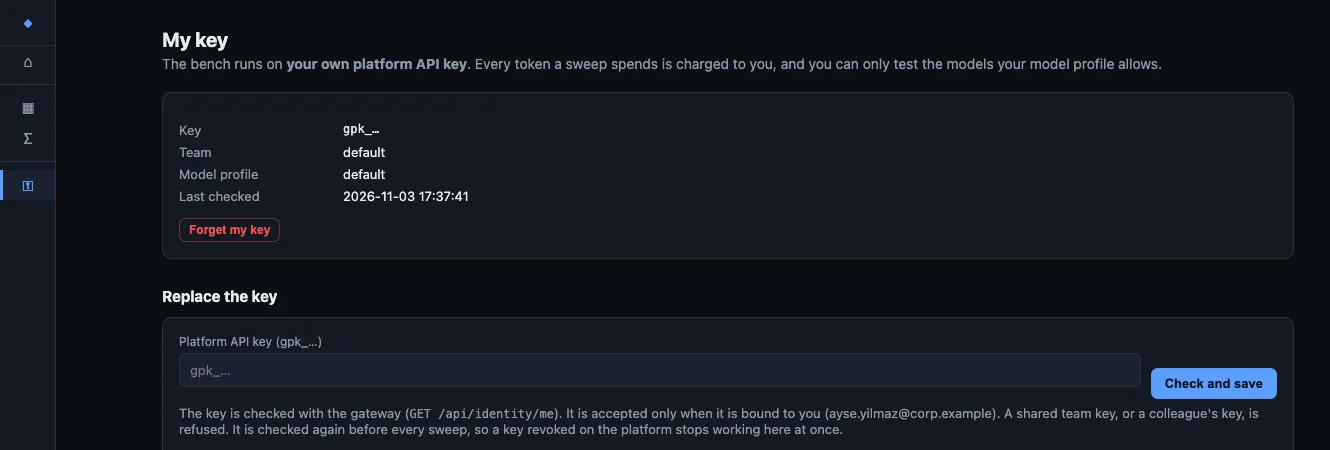
The key is checked again before every sweep, so a key revoked in the console stops working here at once.
Part 2 — Run a sweep
The rule that makes a comparison trustworthy: put both providers in one run, so their requests are made close together in time. The bench does not interleave them — one provider’s requests mostly run before the other’s — so a provider getting busier half way through can still tilt the result. Run the sweep twice before you quote it; two separate runs a few minutes apart put even more drift into it.
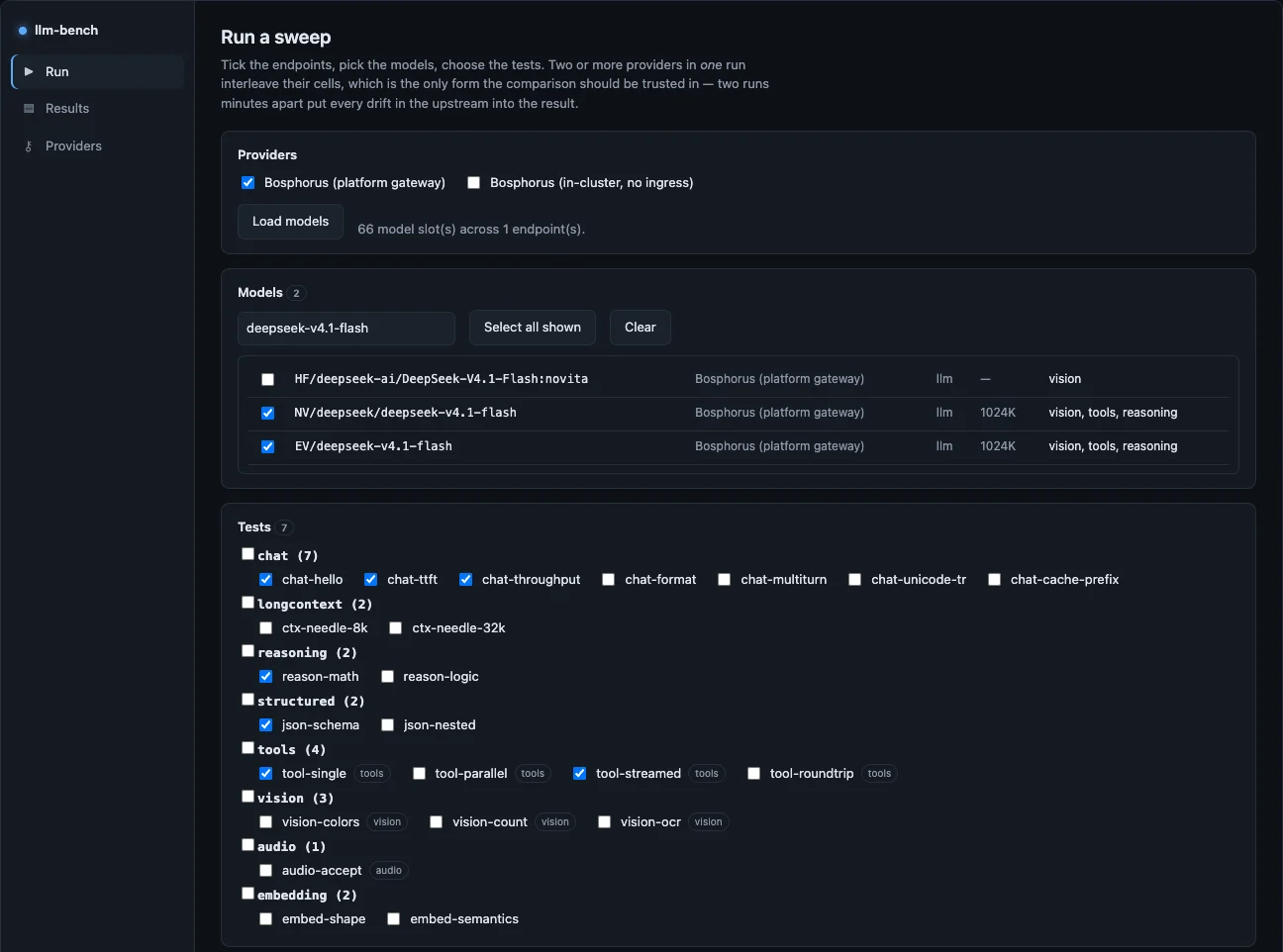
- Go to Bench. Tick one endpoint, Bosphorus (platform gateway), and choose Load models. The list is your own: the models your profile allows.
- Filter by
deepseek-v4.1-flashand tick both providers’ rows:NV/deepseek/deepseek-v4.1-flash(Novita) andEV/deepseek-v4.1-flash(Evren). The prefix names the provider behind the gateway. - Choose the tests. This run used seven:
chat-hello,chat-ttft,chat-throughput,reason-math,json-schema,tool-singleandtool-streamed. - Keep repeats at 3 or more. Below three repeats per cell the analysis refuses to call a difference real.
- Choose Start.
The log and the finished cells appear as the sweep runs. You can leave the page; the sweep continues on the server and its result is saved under Runs & face-off.
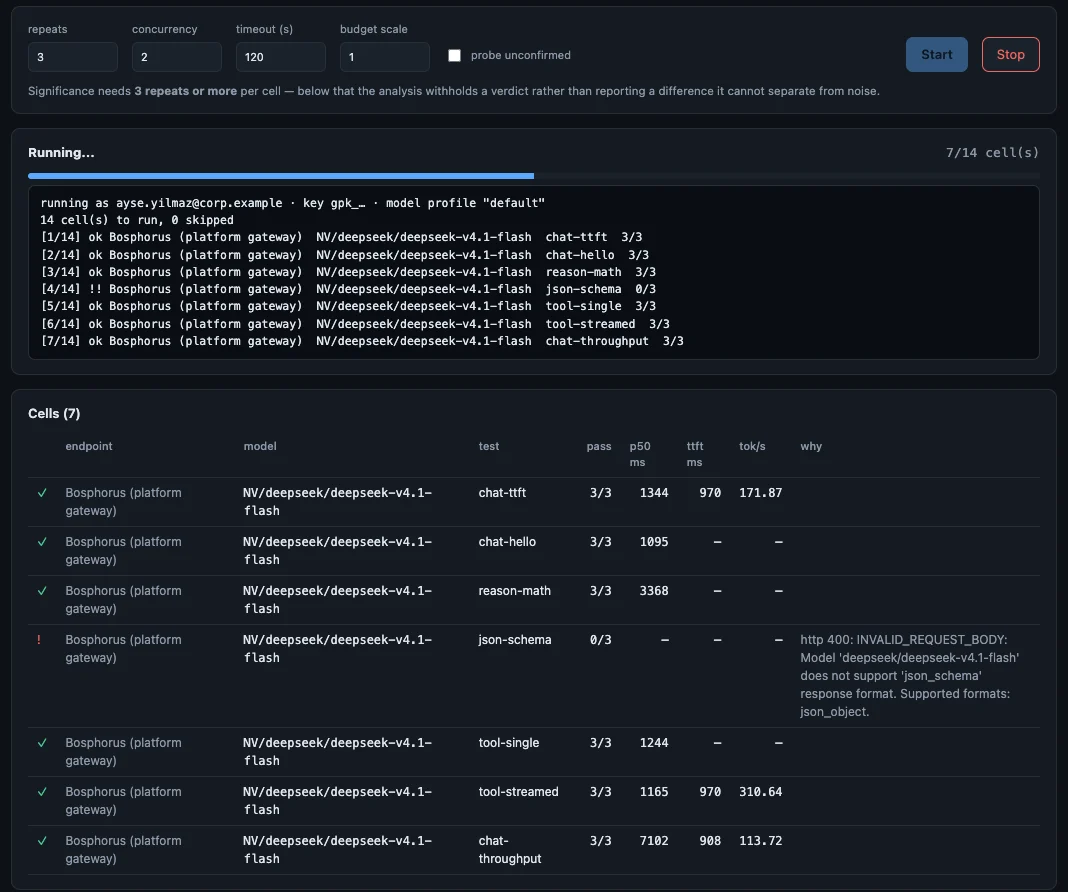
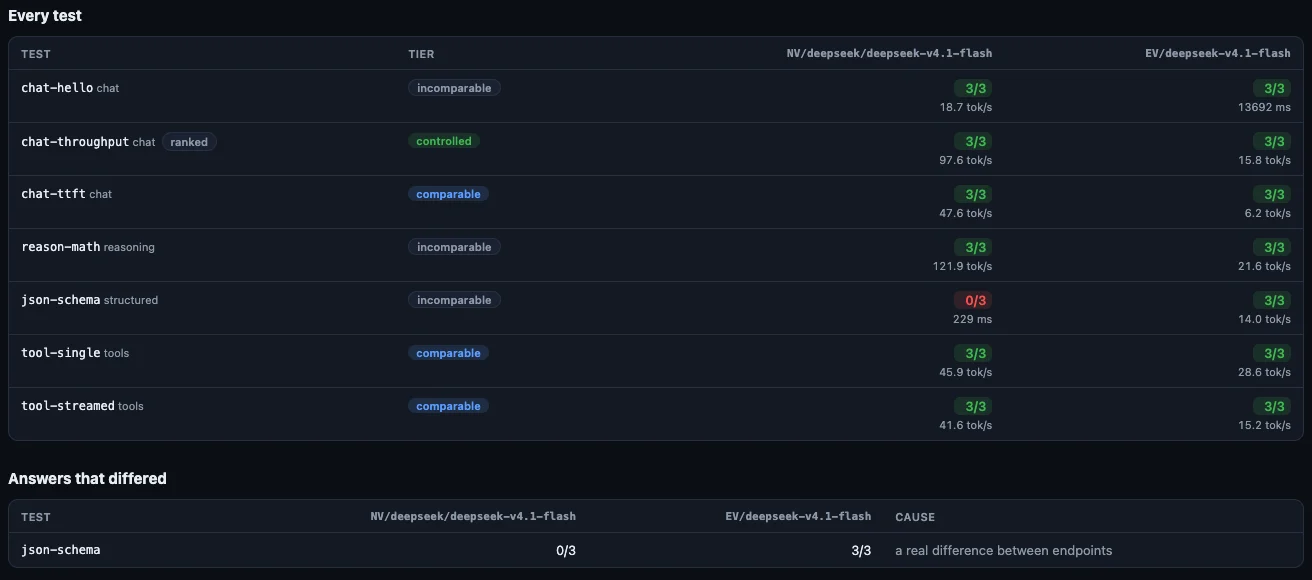
Look at the fourth cell: Novita answered json-schema 0 of 3, with its own error,
INVALID_REQUEST_BODY: Model 'deepseek/deepseek-v4.1-flash' does not support 'json_schema' response format. That is a fact about this provider, not about the model, and it is exactly
the kind of thing the comparison is for.
Part 3 — Read the face-off
Open the run under Runs & face-off. The page leads with the verdict, then one card per provider.
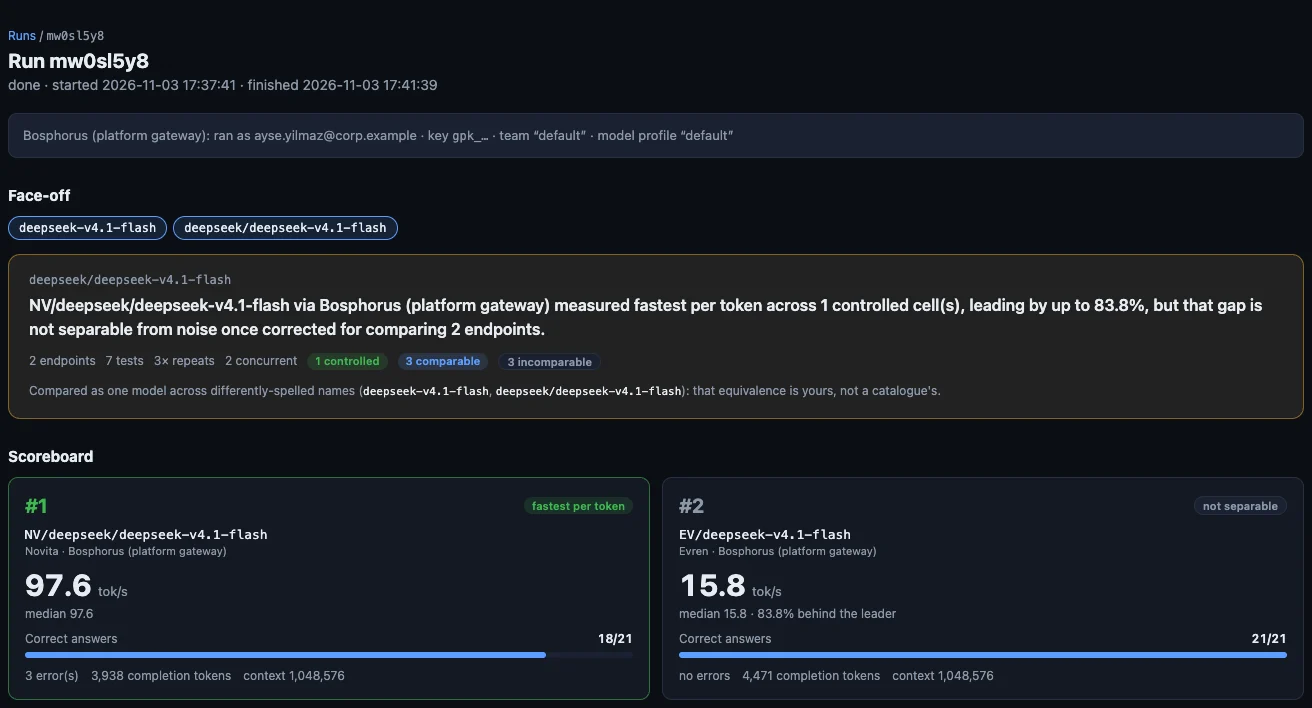
What this run says:
- Novita measured faster per token: 97.6 tok/s against 15.8, 83.8 % ahead. The verdict
also says the gap is not separable from noise: only one test (
chat-throughput) kept the answer length equal on both sides, and one cell is not enough for a significance test. The app says so rather than presenting the gap as proven. - Evren answered every test correctly: 21 of 21. Novita scored 18 of 21; the three misses
are the three
json-schemaattempts it refused. - The two providers name the model differently (
deepseek-v4.1-flashanddeepseek/deepseek-v4.1-flash). They were compared as one model because you ticked both; the page says that the equivalence is yours, not a catalogue’s.
Where the time goes splits the request into its parts. The best provider is always the full bar.
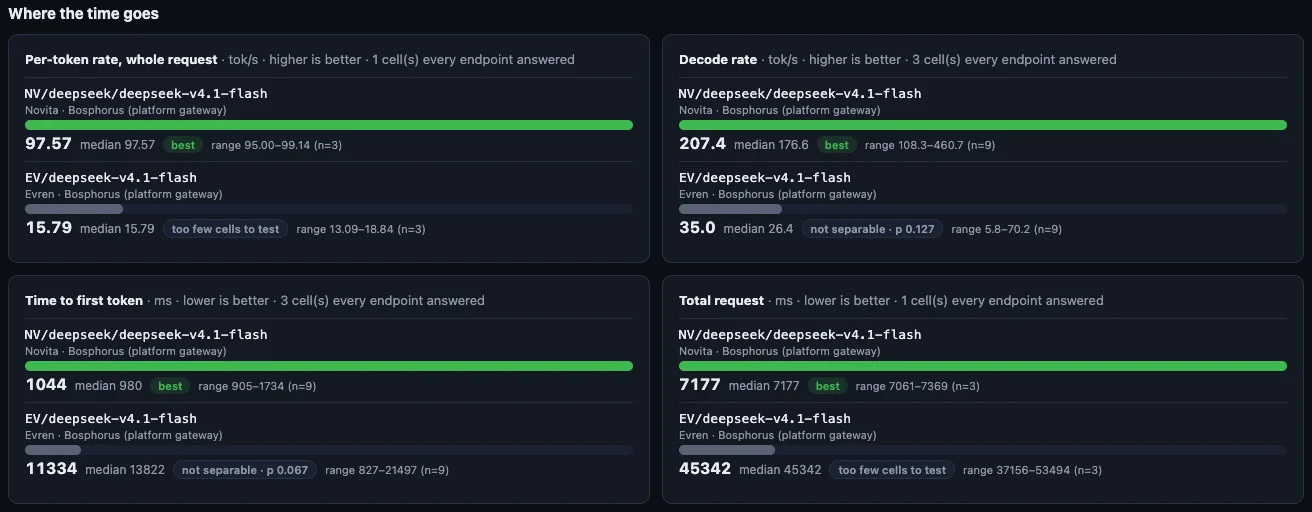
| Measure | Novita | Evren |
|---|---|---|
| Time to first token, mean (ms) | 1,044 | 11,334 |
| Decode rate, mean (tok/s) | 207.4 | 35.0 |
Total request, chat-throughput (ms) |
7,177 | 45,342 |
The first token gap is the largest: about one second against about eleven. Each panel carries the p-value of a paired test, corrected for comparing several providers; here none is below 0.05, so the app marks them not separable. Three repeats and one controlled test are a quick look; raise the repeats and add tests before you quote a number.
Every test shows each test for each provider, and Answers that differed lists the tests where the providers disagreed.
The section Read these before quoting a number, at the end of the page, lists every caveat of this run. Read it before you forward a result.
Export the result
The run page offers the face-off as Markdown (for a ticket or a document) and CSV (one row per test and provider, for a spreadsheet), and the whole run file as JSON. None of them contains your key.
Every request the sweep made is also on the console’s Activity page under the session
bench-<run id>, and in Usage under the tag llm-bench, so the tokens can be checked
against your own account.
What the benchmark does not prove
- A name is not a checkpoint. Two providers serving “DeepSeek V4.1 Flash” may run different quantisations or versions. The benchmark measures what each one serves; it cannot prove the weights are identical.
- One run is a sample. It measures that hour, from inside the installation. A provider’s speed changes with its load.
- Every check is deterministic. No answer is scored by another model, so a verdict does not depend on the speed or availability of a judge.